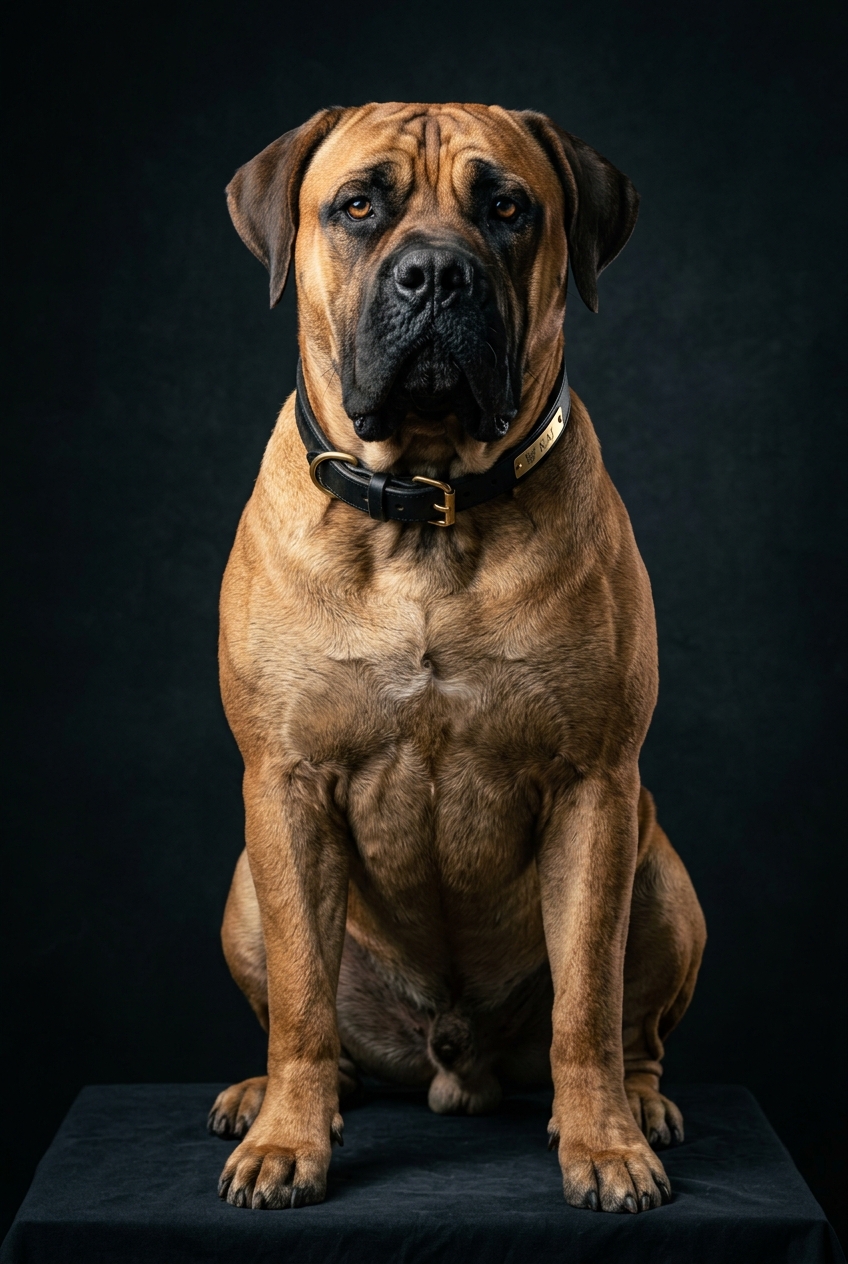
Evaluate Boerboel type, structure and movement, understand the real health-testing panel (hips, elbows, heart, VH and DNA), and learn the ethics and business of responsible breeding.
Lessons
5 lessons · 2h 50m01Breed type & the standard 24m+
"Type" is what makes a Boerboel look like a Boerboel — and function like one. Judge the whole dog, not one feature.
Overall impression: A large, strong, imposing mastiff that is still agile and athletic. Males are distinctly masculine with a blockier head; females are feminine but substantial. The dog should look powerful, balanced and capable of doing a day's guarding work.
Head: Broad, deep and square with a defined stop, strong muzzle and complete scissor bite. The head is a hallmark of the breed but must never come at the cost of soundness or breathing.
Body: Deep chest, strong level topline, powerful loin and hindquarters. Rectangular, slightly longer than tall. Skin loose but not excessive.
Movement: Powerful, reaching and efficient — the true test of structure. A dog can "stack" beautifully and still move poorly. Watch it walk and trot from the side, front and rear.
Temperament is part of type: The standard describes a confident, reliable, territorial guardian. A physically typey dog with a weak or vicious temperament is not a good Boerboel. Structure serves function; function serves temperament and job.
02Evaluating structure & movement 30m+
Structure determines whether a dog can work soundly for a decade or breaks down early. Learn to see it.
Front assembly: Look for good shoulder layback and a matching upper arm so the front reaches efficiently. Straight, upright shoulders ("loaded" or "steep" fronts) cause short, pounding steps and early wear. Feet should point forward; watch for east-west feet or down-in-pasterns.
Rear assembly: Moderate, balanced angulation with strong first and second thigh. Over-angulated rears look flashy but can be weak; straight ("posty") rears lack drive. Hocks should be perpendicular and parallel, not cow-hocked (pointing in) or bowed out.
Topline & proportion: A firm, level topline held on the move. Roached or soft toplines and unbalanced proportions signal problems.
Movement is the verdict: From the side, look for good reach in front and drive behind with a level topline. Coming and going, legs should converge toward a centre line ("single-tracking") without crabbing, paddling or crossing.
Balance over extremes: The best Boerboels are moderate and cohesive — front matches rear, everything works together. Beware fads that exaggerate head or bone at the expense of health and movement. Evaluate many dogs, in person, next to good ones, to train your eye.
03Health testing explained 26m+
Responsible breeding starts with objective health data — not opinions. For Boerboels, the core panel is well established.
Hips & elbows (radiographs): The foundation. A certified radiologist grades hips and elbows to screen for dysplasia. SABBS accepts hip statuses of roughly 0:0–1:1 (or FCI A1–C2) and elbows up to 1:1. Formal scoring is done at 24 months; PennHIP can assess earlier. Breeding only sound-hipped/elbowed dogs reduces (never fully eliminates) dysplasia in the line.
Heart: The American Boerboel Club/AKC recommends a cardiac evaluation by a board-certified veterinary cardiologist to screen for dilated cardiomyopathy (DCM) and other issues.
Vaginal hyperplasia (VH): Females should be examined; SABBS requires Grade 0–1 for the Stud Register. VH has a heritable component and affects whelping.
Eyes: Screening for entropion/ectropion (eyelid defects) is recommended.
DNA: A DNA profile is required by SABBS for parentage/identity verification (anti-fraud) — it is NOT a disease test. Commercial panels exist for a few conditions, but there is no validated DNA test for hips, elbows or heart. Juvenile epilepsy has no universal DNA test; affected dogs and close relatives should be removed from breeding.
Bottom line: Test, publish results, and breed away from problems. A pretty pedigree is not a substitute for radiographs and a cardiac exam.
04Responsible breeding ethics 24m+
Breeding Boerboels responsibly is a calling, not a side hustle. The goal is to improve the breed and produce stable, sound, healthy dogs that make owners' lives better.
Breed to improve, not to multiply: Every pairing should aim to fix faults and strengthen virtues in temperament, health and structure. Never breed two dogs with the same weakness. Don't breed a dog just because it's yours and it's intact.
Temperament first: A structurally beautiful dog with a nervous, sharp or unstable temperament should not be bred. The breed's future depends on reliable guardians, not liabilities.
Health-tested parents only: Hips, elbows, heart, VH and eyes as covered — with results you're willing to publish. Maturity matters; evaluate breeding candidates at 18+ months.
Ethics of placement: Screen buyers as carefully as you screen your dogs. Use a solid contract, a health guarantee, spay/neuter or co-ownership terms where appropriate, and a lifetime take-back clause so no dog you bred ends up in a shelter.
Do no harm: Support your puppy buyers for life, be honest about the breed's demands, turn away wrong-fit homes, and be willing to NOT breed a litter if the right pairing isn't there. Restraint is a hallmark of a great breeder.
05Selecting a puppy from a litter 26m+
Whether you're a buyer or a breeder placing puppies, matching the right puppy to the right home is everything.
Match temperament to lifestyle, not looks: The boldest, pushiest puppy is not "the best" — it's the right pick only for an experienced, active handler. The middle-of-the-road, confident-but-biddable puppy suits most guardian homes. A softer, more sensitive puppy can be perfect for a calmer household. Colour and markings should be the LAST consideration.
What to watch for: A well-run breeder temperament-tests the litter and observes each puppy over weeks. Look for recovery (does a startled pup bounce back quickly?), sociability (does it engage with people?), sound sensitivity, and handling tolerance. Avoid extremes of fearfulness or frantic overarousal.
Environment tells the story: Puppies should be raised in the home, clean, well-fed to a lean condition, handled daily, and started on early neurological stimulation and novelty exposure. Meet the dam (and see her temperament); ask to see health testing on both parents.
Questions a good breeder welcomes: Health results, what they're breeding for, how they raise litters, what support they offer, and their take-back policy. A breeder who interviews YOU hard is usually a breeder worth buying from.
Set the puppy up: Continue socialisation, controlled growth nutrition and calm leadership from day one — the breeder hands you a great start; you finish the job.